






 |
 |
 |
 |
 |
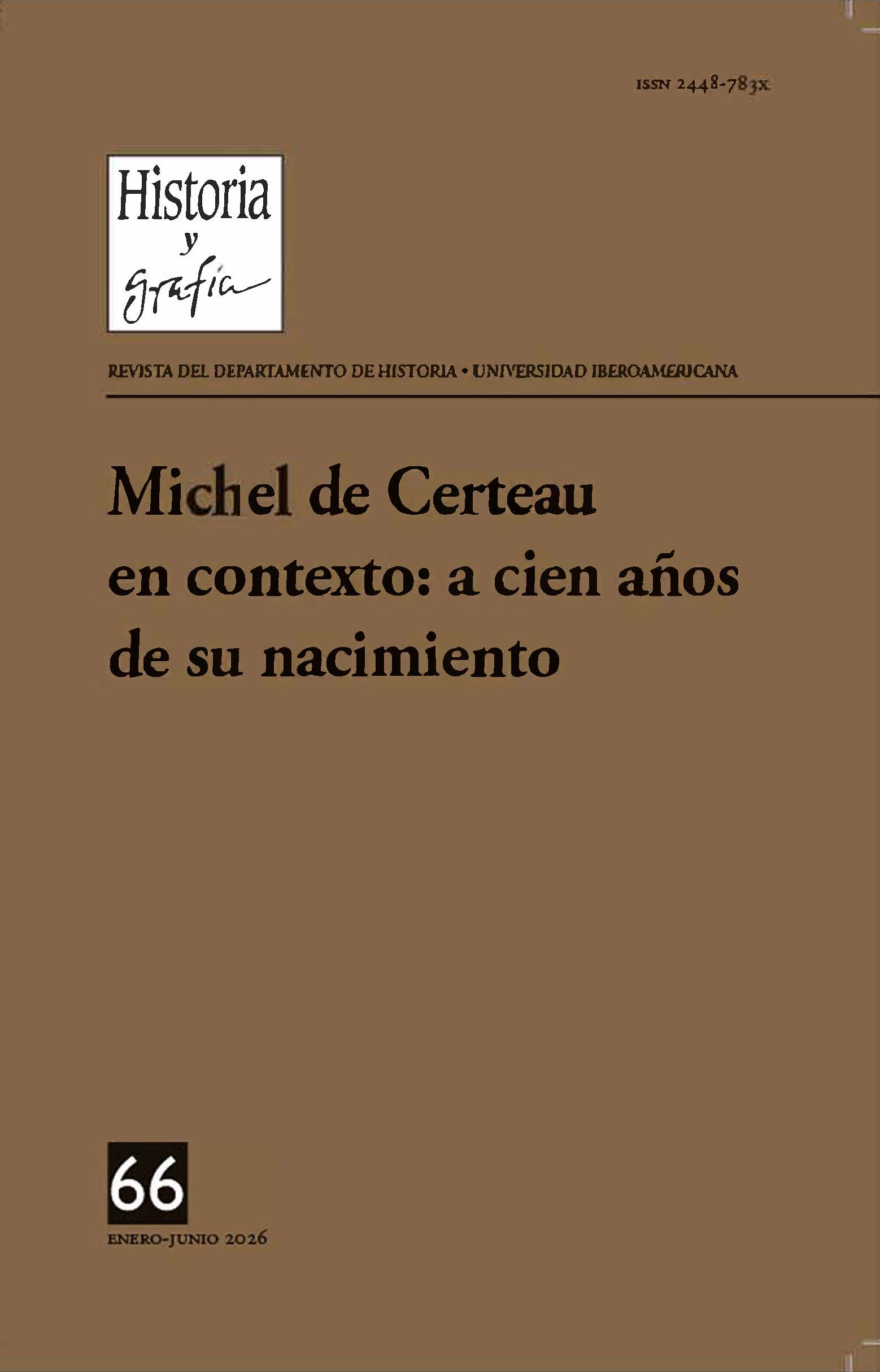
No. 66 (2026): Michel de Certeau in Context: One Hundred Years after his Birth
In 2025, we marked the 100th anniversary of the birth of French Jesuit Michel de Certeau (1922-1986). De Certeau's work and thought hold a crucial place not only in the foundation of the journal Historia y Grafía but also in inspiring an entire intellectual project within the History Department at the Ibero-American University. This dossier consists of four articles that revolve around the following questions: How can we rethink de Certeau's intellectual legacy today, 100 years after his birth? What clues can we find to understand the context in which he developed his thought? How can we interpret the hidden intentions in his reading and writing gestures, which we encounter through his texts that were generally not intended to become books?
In debate section:
Historical Past: Discovered or Invented? A Debate Between Historiographical Realism and Constructivism by Mariana Ímaz Sheinbaum y Aurelia Valero Pie.
The opposition between historiographical “realism” and “constructivism” has framed a heated and very rich discussion that, in recent times, has involved several of the most renowned authors in the field of theory and philosophy of history. Although the terms themselves are controversial and have warranted extensive analysis and even personal clarifications, “historiographical realism” is generally understood, broadly speaking, as the idea that historical facts are independent of the work of the historian, whose task is to reconstruct them as objectively and completely as possible based on the available evidence. On the other hand, “historiographical constructivism”—or “anti-realism,” as its detractors call it—often designates the position that questions not so much the possibility of establishing factual events, but rather whether these events themselves contain or exhaust their meaning. Hence, explanatory or narrative frameworks appear as the main source of meaning. Although one might think that the age-old dispute between realism and nominalism, materialism and idealism, positivism and historicism is once again on the table, the theoretical coordinates have shifted since then and are now enriched by exchanges with analytic philosophy, the philosophy of science, and literary theory, though not exclusively. Far more relevant than its relative novelty, however, is that this debate has raised central questions of our understanding and practice of history: How is the past conceived, and what are its implications? What are the scope and limits of historical knowledge? How do we evaluate competing narratives? What role—epistemological, political, and social—do those of us who practice this profession play? With the aim of contrasting positions and inviting contributions to the collective dialogue, in this debate section we present a series of interviews with four renowned figures in the theory and philosophy of history: Paul Roth, Kalle Pihlainen, Adrian Currie, and Daniel Swaim. All of them have produced seminal works in their respective fields, and their voices are frequently heard in the controversies that shape the discipline, including the debate between historiographical constructivism and realism. We have divided their contributions into two parts, which will appear in consecutive issues of Historia y Grafía: Roth and Pihlainen's in issue 66, and Currie and Swaim's in issue 67. We hope that their personal and very different responses will encourage us to continue reflecting on the theoretical foundations of history, as well as its implications for our profession.
Publicado: 31/12/2025










Tell us your doubts


_(1)2.png)